

Study Finds Manufacturing Capacity Loss Concentrated Outside of Machines
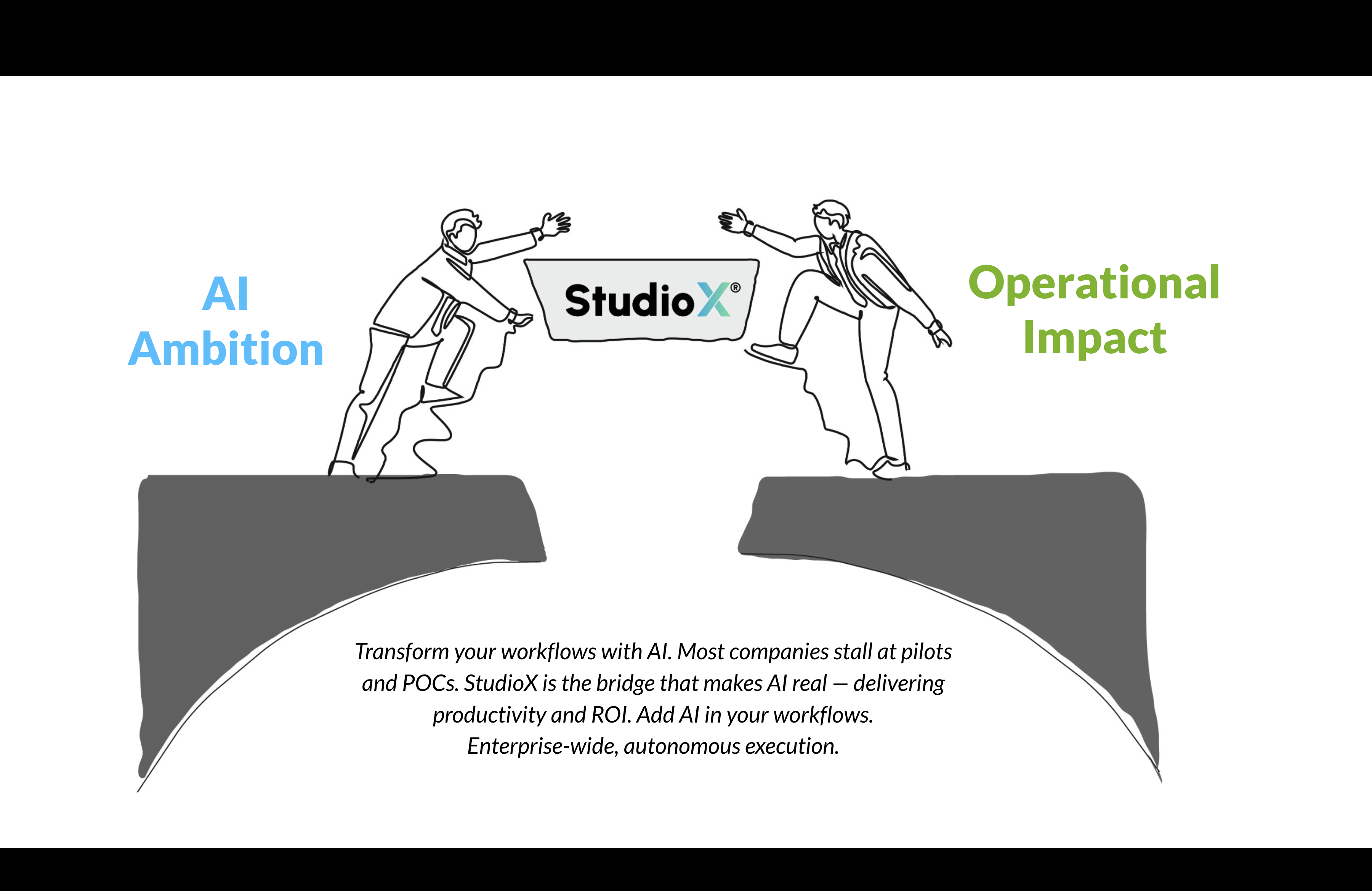
StudioX - From AI Ambition to Real Impact
StudioX analysis finds AI investment has focused on equipment, while significant capacity losses occur in surrounding workflows.
We've spent decades optimizing machines. The next wave of manufacturing productivity will come from optimizing the work between them.”
SAN JOSE, CA, UNITED STATES, December 15, 2025 /EINPresswire.com/ -- StudioX today released a new analysis revealing a critical and long-overlooked reality in manufacturing: while automation and AI have historically focused on machines and production assets, the largest operational losses occur in the manual workflows that surround them.— Ajay Malik, CEO, StudioX
According to Armand V. Feigenbaum, the quality management pioneer whose work shaped Total Quality Management, between 20% and 40% of total manufacturing capacity is consumed by what he termed the “hidden factory” — the rework, workarounds, coordination, and problem-solving that happen outside formal processes.¹
While Feigenbaum’s original framing focused on quality-related inefficiencies, manufacturers today increasingly use the term to describe a broader, systemic layer of unseen work: the communication, escalations, and non-routine decision-making required to keep production running but rarely measured or automated.
Despite decades of investment in robotics, IoT, MES, machine vision, and predictive maintenance, most day-to-day work inside factories remains manual. This includes activities such as maintenance triage, quality response and escalation, shift handovers, supplier and material risk management, searching SOPs and historical documentation, pulling data from ERP and MES dashboards, and coordinating quotes and customer support.
“These workflow-level activities represent some of the largest sources of lost capacity in manufacturing — yet they’ve remained largely invisible to traditional automation,” the analysis notes.
The cost of these inefficiencies continues to grow. Typical factory OEE still ranges between 40% and 60%, according to multiple industry benchmarks.² Meanwhile, unplanned downtime costs the world’s 500 largest companies an estimated $1.4 trillion annually, or roughly 11% of revenues, according to Siemens’ True Cost of Downtime 2024 report.³
At the same time, industrial AI investment has overwhelmingly targeted machines rather than workflows. IoT Analytics’ Industrial AI Market Report 2025–2030 finds that most industrial AI value today comes from sensor time-series analysis, machine vision, and simulation — technologies designed for assets, not for the coordination and decision-making that connect them.⁴
“AI has delivered tremendous value at the machine level, but the next wave of transformation will come from addressing the workflows between them,” said Ajay Malik, CEO of StudioX. “The decisions, handoffs, and problem-solving loops that make up the modern hidden factory consume enormous effort yet remain largely untouched by automation. Workflow-native, no-code AI finally gives manufacturers a practical way to close that gap — right where the work actually happens.”
The analysis highlights practical examples of hidden-factory workflows that workflow-native AI can now automate, including operational workflows such as quality alerts, shift handovers, maintenance triage, and supplier notifications triggered by sensor anomalies, as well as information-driven workflows like knowledge search across SOPs, conversational ERP dashboards, automated quote creation, and customer-support routing.
These processes often span dozens of emails, messages, approvals, and micro-decisions — work that traditional industrial automation was never designed to handle.
By enabling frontline teams to design and deploy AI-driven workflows without writing code, manufacturers can reduce hidden-factory losses, improve Overall Equipment Effectiveness, accelerate response times, and unlock meaningful operational capacity without additional hardware investment.
About the Analysis
The Hidden Factory: Why AI Has Missed Manufacturing’s Most Expensive Workflows is a new insight paper from StudioX that builds on established research in manufacturing quality and operations. The analysis examines why decades of automation and AI investment have focused on machines while leaving workflow-level inefficiencies largely unaddressed — and outlines how workflow-native, no-code AI enables manufacturers to finally close this gap.
Call to Action
Manufacturers interested in identifying their own hidden-factory workflows can request a proof-of-concept assessment to evaluate how workflow-native AI can reduce rework, eliminate delays, and accelerate operations.
https://30mins.com/studiox/call/
About StudioX
StudioX is the Enterprise AI Engine that helps organizations become autonomous. Built for real work at real scale, StudioX combines generative and classical AI with prediction, detection, anomaly identification, and workflow-native automation. With government-grade deployment options and a no-code extensibility framework (Vibes), StudioX enables teams to embed AI directly into core workflows across operations, customer support, and products—without writing code. Organizations use StudioX to drive revenue, reduce costs, and deliver consistent, high-quality outcomes at scale.
Jacob Vandersteen
StudioX-AI.com
+1 408-203-5641
email us here
Visit us on social media:
LinkedIn
Legal Disclaimer:
EIN Presswire provides this news content "as is" without warranty of any kind. We do not accept any responsibility or liability for the accuracy, content, images, videos, licenses, completeness, legality, or reliability of the information contained in this article. If you have any complaints or copyright issues related to this article, kindly contact the author above.
