

Medical Device Testing Services Market to reach USD 28.05 Billion by 2035 at 10.1% CAGR
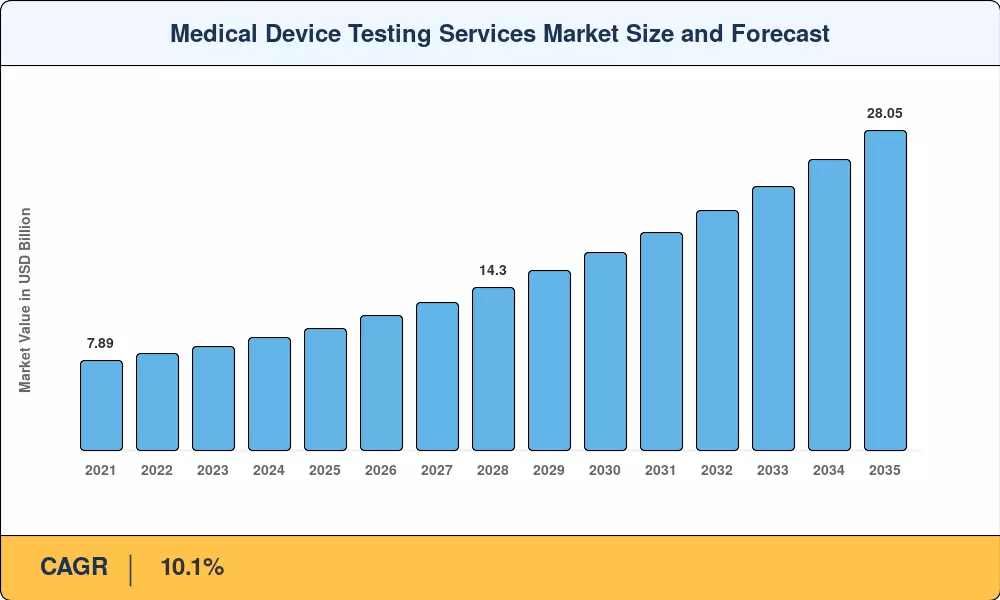
Medical Device Testing Services Market Size
Medical Device Testing Services Market to Surge from USD 11.80 Billion in 2026 to USD 28.05 Billion by 2035---Powered by FDA Cybersecurity Pre-Market Mandates
NY, CA, UNITED STATES, June 19, 2026 /EINPresswire.com/ -- As per Market Research Future, the global Medical Device Testing Services Market size to reach USD 28.05 Billion by 2035 from USD 11.80 Billion in 2026, at a CAGR of 10.1% during the forecast period 2026--2035. The market base was estimated at USD 10.72 Billion in 2025.The 10.1% CAGR---anchored by structural regulatory compliance demand rather than discretionary healthcare spending---is driven by three converging forces: the FDA's 2023 cybersecurity pre-market guidance that compels every connected-device maker to demonstrate threat modeling and software bill-of-materials integrity before clearance, sustained EU MDR transition deadlines that have funneled thousands of legacy CE-marked products back through conformity assessment and overwhelmed in-house validation teams, and the proliferation of connected wearables and AI-enabled implantables that must undergo rigorous electromagnetic compatibility screening, software lifecycle verification, and wireless coexistence testing before market entry.
National governments and multilateral health organizations are amplifying this momentum. The FDA's 2023 final guidance on cybersecurity in medical devices now makes a software bill of materials (SBOM) and threat-model documentation mandatory for every pre-market submission involving connected functionality.
The EU MDR's Article 120 transition timeline forced an estimated 23,000 legacy devices through full re-certification by May 2024, generating a backlog that notified bodies still process at constrained throughput---Medtech Europe reported a 42% shortfall in notified-body audit capacity as recently as Q1 2025.
Request A Free Sample:
https://www.marketresearchfuture.com/sample_request/12353
Key Market Trends & Growth Drivers
FDA Cybersecurity Pre-Market Mandates and AI/ML Device Surge
The FDA's 2023 final guidance on cybersecurity in medical devices now makes a software bill of materials (SBOM) and threat-model documentation mandatory for every pre-market submission involving connected functionality.
By early 2026, the FDA had authorized over 1,350 AI-enabled medical devices, a significant increase from 2022 figures. This growth trajectory necessitates rigorous electromagnetic compatibility (EMC) screening, software lifecycle verification, and wireless coexistence testing. Simultaneously, the global wearable health technology market is experiencing sustained expansion, with billions of units currently active. Every new variant or software update for these connected devices must undergo stringent biocompatibility, electrical safety, and human-factors validation before market entry, driving demand for specialized third-party medical device testing services.
EU MDR Re-Certification Backlog and Notified-Body Capacity Constraints
Legacy CE-marked devices under the Medical Device Directive are yielding to full MDR conformity assessments, with the EU MDR's Article 120 transition timeline forcing an estimated 23,000 legacy devices through full re-certification by May 2024. Europe currently operates with only 39 MDR-designated notified bodies, down from over 80 under the legacy Medical Device Directive.
This shortage creates audit backlogs that slow device re-certification and, by extension, delay the downstream testing campaigns that manufacturers schedule around conformity assessment timelines. The bottleneck temporarily suppresses the volume of testing engagements that labs can initiate, even though total addressable demand remains elevated.
Connected-Device Proliferation and Outsourcing Shift
The high fixed costs associated with maintaining internal, ISO 17025-accredited testing laboratories---which include specialized equipment, facility overhead, and highly trained personnel---have incentivized mid-tier and large-scale device manufacturers to shift toward external testing partners.
Industry trends indicate that third-party labs, which aggregate testing demand across numerous OEMs, are becoming the preferred model for pre-clinical biocompatibility and safety testing. This structural move allows manufacturers to optimize R&D expenditure and reduce time-to-market by leveraging the broader, validated scope of accreditation held by global testing organizations.
Ask for Customization:
https://www.marketresearchfuture.com/ask_for_customize/12353
Market Segment Insights
BY SERVICE TYPE
Biocompatibility Testing: Dominant segment with ~32.0% revenue share in 2024. Reflecting the non-negotiable nature of ISO 10993 requirements across all device classes. Biocompatibility testing remains the single largest service category because virtually every device that contacts patient tissue, blood, or mucosal surfaces must generate a biological evaluation file under ISO 10993. The scope ranges from cytotoxicity and sensitization assays through chronic implantation studies that can run 26 weeks or longer for Class III products.
Electrical Safety & EMC Testing: Fastest-growing service segment at 14.5% CAGR (2026--2035). Driven by the proliferation of connected wearables and AI-enabled implantables. Electrical safety and EMC testing is catching up as the fastest-growing segment because connected devices---from Bluetooth-enabled insulin pumps to RF-communicating surgical robots---must satisfy IEC 60601-1-2 Ed. 4 electromagnetic compatibility suites alongside traditional electrical leakage and dielectric strength protocols.
BY DEVELOPMENT PHASE
Pre-Clinical Testing: Dominant phase with ~47.5% revenue share in 2024. Front-loaded regulatory evidence requirements dominate volume. Pre-clinical testing dominates spending because regulators across all major jurisdictions require exhaustive bench and animal data before granting first-in-human study approvals.
Post-Market Surveillance Testing: Fastest-growing phase segment at 13.8% CAGR (2026--2035). Fueled by MDR Article 83 obligations and FDA post-market cybersecurity mandates. The medical device testing services market sees the fastest growth in post-market surveillance, where the EU MDR's periodic safety update report (PSUR) and post-market clinical follow-up (PMCF) obligations compel manufacturers to maintain continuous testing relationships well beyond initial market clearance.
BY DEVICE CLASS
Class II Devices: Dominant device class with ~55.0% revenue share in 2024. Reflecting the largest device population by SKU count. Class II devices generate the majority of testing revenue simply because this classification encompasses the broadest spectrum of products---from powered surgical instruments to diagnostic imaging accessories---that require substantial equivalence evidence under the 510(k) pathway.
Class III Devices: Fastest-growing device class at 14.8% CAGR (2026--2035). Tied to rising complexity in combination products and AI/ML-enabled diagnostics. Class III device testing grows fastest because these high-risk products demand the most extensive test programs, often spanning multi-year implantation studies, fatigue and wear testing, and full electrical safety suites.
BY END USER
Medical Device OEMs: Dominant end-user segment with ~61.0% revenue share in 2024. Direct regulatory submission responsibility drives volume. OEMs remain the dominant end-user segment because they carry direct responsibility for assembling the regulatory dossier---and therefore for commissioning every test that populates it.
Contract Research Organizations: Fastest-growing end-user segment at 12.8% CAGR (2026--2035). CRO-mediated outsourcing accelerates among mid-tier manufacturers. Contract research organizations represent the fastest-growing channel as mid-tier and start-up device companies increasingly delegate entire testing programs to CROs capable of managing multi-site, multi-jurisdiction campaigns under a single master service agreement.
Read Detailed Insights:
https://www.marketresearchfuture.com/reports/medical-device-testing-services-market-12353
Regional Outlook
North America -- Dominant Market (~39.2% Share, 2024)
The United States generates approximately 82.3% of North American Medical Device Testing Services Market revenue, driven by the world's most extensive network of FDA-registered testing labs and a substantial MedTech OEM presence focused in Minnesota, Massachusetts, and Southern California---a single policy ecosystem that converted an in-house-dominated market into one with a structural third-party testing tail.
The US dominates through a combination of the FDA's pre-market review system touching an estimated 6,200 device submissions annually, aggressive cybersecurity mandate adoption, and rapid AI/ML device authorization growth.
Europe -- Second Largest (~26.5% Share, 2024)
Europe's Medical Device Testing Services Market reflects divergent national strategies---Germany leads regionally with TÜV/DEKRA notified-body concentration, contributing ~23.8% of regional share, while the UK historically used selective testing targeting before broadening coverage through post-Brexit UKCA marking requirements at 11.4% CAGR.
France contributes ~15.2% of regional share through LNE/G-MED accreditation hub leadership. Italy contributes USD 0.38 Billion on orthopedic and cardiovascular device cluster demand. Spain contributes ~6.1% of regional share on growing IVD manufacturing base.
Asia-Pacific -- Fastest-Growing Region (13.0% CAGR, 2026--2035)
Asia-Pacific is the engine of the Medical Device Testing Services Market. China holds the largest regional share with ~34.6% of regional revenue, driven by NMPA reform and domestic OEM expansion---China's NMPA processed over 18,000 device registrations in 2024, a 22% increase over 2022, and mandated third-party testing for all Class III and select Class II products.
India is growing at 14.8% CAGR on the back of CDSCO Medical Device Rules 2023, requiring performance-testing evidence from NABL-accredited laboratories for higher-risk categories. Japan contributes ~22.1% of regional share through PMDA quality standards and aging-society device demand at steady pace. South Korea holds ~12.5% of regional share on MFDS K-MDR framework adoption.
Middle East & Africa -- Emerging Opportunity (5.7% Share, 2024)
The Middle East & Africa carries the widest infrastructure gap and therefore the steepest opportunity. Saudi Arabia leads the region with Vision 2030 healthcare investment, contributing ~28.3% of regional share---the SFDA published updated guidance on electromagnetic compatibility testing in 2024, aligned with IEC 60601-1-2 Ed. 4, creating new testing mandates for the estimated 18,000 device registrations processed annually.
The UAE contributes ~24.7% of regional share on Dubai MedTech hub and MOH registration requirements. South Africa holds ~19.2% of regional share on SAHPRA medical device regulation rollout.
South America -- Growing Presence (USD 0.62 Billion, 2025)
Brazil anchors South America's Medical Device Testing Services Market at ~62.4% of regional revenue, with ANVISA's progressive tightening of good manufacturing practice inspections for imported devices since 2020, requiring detailed test reports from ISO 17025-accredited facilities as part of the ANVISA registration dossier.
This policy creates a captive testing-demand stream for every multinational targeting the Brazilian market, which imported approximately USD 4.2 billion in medical devices in 2024, providing a stable demand floor that smooths regional forecasts. Argentina contributes ~18.1% of regional share on ANMAT device classification system alignment.
Competitive Landscape and Recent Developments
The Medical Device Testing Services Market is moderately fragmented. The top five players hold an estimated 32--36% combined revenue share, with the rest of the majority coming from a lengthy tail of specialized regional laboratories. The Herfindahl-Hirschman Index (HHI) is in the range of 600--900, suggesting a fairly fragmented business with scale advantages in the breadth of accreditations and geography being supplemented with specialty knowledge in some test areas. M&A activity suggests that the top-five share will climb past 40% by 2030 as platform-scale economics reward breadth of accreditation.
The competitive landscape is stratified between broadest global lab network leaders serving multi-jurisdiction OEMs, strong EU MDR conformity assessment specialists capturing re-certification tenders, and deep IEC/FDA expertise providers consolidating the electrical safety and cybersecurity testing segment.
KEY COMPANIES AND RECENT MILESTONES
SGS SA (2024--2025): Maintains leadership with biocompatibility, sterilization validation, and EMC testing, commanding ~7--9% of global Medical Device Testing Services Market revenue. Broadest global lab network with 2,600+ offices serves multi-jurisdiction OEMs worldwide. Premium positioning in comprehensive accreditation breadth offsets price compression in commoditized segments.
Bureau Veritas (2024--2025): Material characterization and regulatory consulting anchor a strong EU MDR conformity assessment positioning, holding ~5--7% of global revenue. The company benefits from the structural MDR re-certification tail created by expanded notified-body engagement.
Future Outlook: 2026--2035
By 2030, AI-integrated testing workflows and in-silico platform economics will become the operating system of medical device validation. Machine-learning algorithms capable of predicting biocompatibility endpoints from chemical-structure databases---such as QSAR models accepted under revised OECD guidelines---could reduce animal-study requirements by 30--40% for qualifying materials by 2030.
Labs that embed AI triaging into their intake workflows will deliver faster turnaround and attract the growing cohort of software-as-a-medical-device (SaMD) developers whose products iterate on six-month cycles rather than multi-year design-freeze timelines. Robotic sample-handling systems paired with machine-learning-based anomaly detection can increase lab throughput by 40--50% while reducing human error rates. Labs that invest in automation platforms will capture throughput-sensitive OEM contracts as product refresh cycles compress below 18 months.
More Related Research Insights:
https://www.marketresearchfuture.com/reports/medical-device-testing-services-market-12353
https://www.marketresearchfuture.com/reports/medical-device-contract-manufacturing-market-11204
https://www.marketresearchfuture.com/reports/medical-device-outsourcing-market-67304
https://www.marketresearchfuture.com/reports/in-vitro-diagnostics-market-1165
https://www.marketresearchfuture.com/reports/clinical-laboratory-services-market-7145
https://www.marketresearchfuture.com/reports/quality-management-software-market-5491
https://www.marketresearchfuture.com/reports/biocompatible-coating-market-32168
https://www.marketresearchfuture.com/reports/sterility-testing-market-547
https://www.marketresearchfuture.com/reports/pharmaceutical-analytical-testing-outsourcing-market-7188
Larry Wilson
WantStats Research And Media Pvt. Ltd.
+1 855-661-4441
email us here
Visit us on social media:
LinkedIn
Facebook
YouTube
X
Legal Disclaimer:
EIN Presswire provides this news content "as is" without warranty of any kind. We do not accept any responsibility or liability for the accuracy, content, images, videos, licenses, completeness, legality, or reliability of the information contained in this article. If you have any complaints or copyright issues related to this article, kindly contact the author above.
